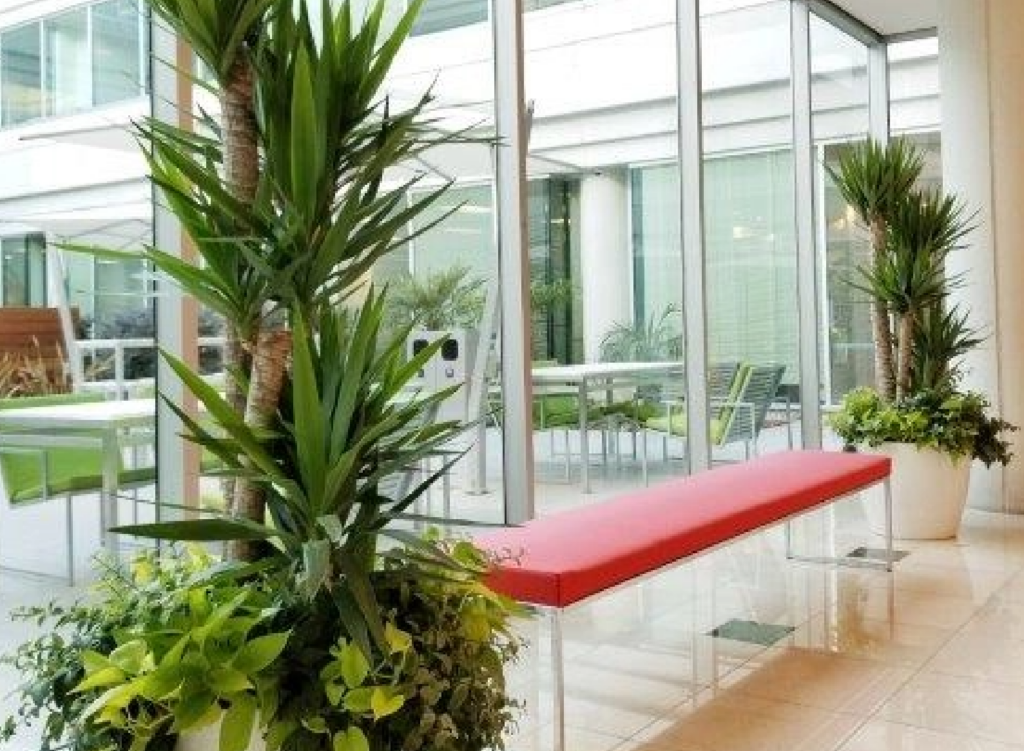
Some commercial spaces are not well suited to living plants. Low light, limited access, strong HVAC airflow, high shelves, and inconsistent maintenance can all make healthy growth difficult.
Replica plants offer a practical way to bring greenery into challenging interiors without requiring living material to thrive there. When professionally selected and placed, they can add scale, color, softness, and visual consistency. The key is to treat replica greenery as part of the overall design rather than as a fallback.
Low-Light Areas Can Still Benefit From Greenery
Light is one of the most important factors in plant performance. A living plant placed too far from windows or under insufficient artificial light may gradually thin, fade, or decline even when watering is handled correctly.
Replica plants can work well in spaces such as:
- Interior corridors with little natural light
- Windowless meeting rooms or waiting areas
- Deep corners far from exterior glass
- High shelves that are difficult to service
- Areas with strong air-conditioning or temperature swings
- Display zones where consistent appearance matters most
Professional designers still consider scale, containers, finishes, and sightlines so the greenery feels intentional within the architecture.
A discussion of workplace plant selection also shows why live plants should be matched to real lighting, airflow, and maintenance conditions. Replica plants become especially useful when those requirements cannot be met reliably.
Replica Greenery Keeps Difficult Areas Visually Consistent
High-traffic commercial interiors need to stay polished. Reception areas, retail spaces, hotels, and offices may have sections where living plants are bumped, neglected, or exposed to conditions that cause uneven growth.
Replica greenery removes many of those biological variables. It does not wilt, drop leaves, outgrow its location, or react to changing light levels. That makes it useful where the visual standard needs to remain stable.
Design quality still matters. Replica plants vary in realism, proportion, texture, and finish. Professional selection helps avoid pieces that look undersized or artificial. Paired with a suitable container and surrounding décor, the finished display can support the room naturally.
Difficult Access Can Make Live Plant Maintenance Impractical
Some spaces can support living plants but are inefficient to maintain. Tall ledges, enclosed displays, narrow landings, or blocked service access can make routine care unnecessarily difficult.
Replica plants can be considered for:
- Elevated ledges requiring special access
- Narrow areas where technicians cannot work comfortably
- Conference rooms with tightly arranged furniture
- Decorative niches with limited watering access
- Spaces where soil or water would create operational concerns
- Short-term layouts that may change frequently
These areas still need occasional cleaning, but not watering, pruning, fertilizing, or plant-health monitoring. That can simplify the plant program while reserving living plants for suitable locations.
A Mixed Plant Strategy Often Works Better Than One Approach
Commercial interiors do not have to choose exclusively between living and replica plants. A stronger design can use each where it makes the most sense.
Living greenery may be ideal near windows, in lobbies, or in areas where regular plant care is easy to provide. Replica plants can extend the design into darker, harder-to-reach, or operationally sensitive spaces. Preserved moss walls, living walls, and other plant features can add another layer where floor space or maintenance needs differ.
Professional plant maintenance programs are built around light, airflow, soil, placement, and long-term presentation. That same site-specific thinking helps determine when a live plant should remain, when a different species would perform better, and when replica greenery is the more practical design choice.
This blended approach creates continuity without forcing every area to support the same type of planting.
Professional Design Helps Replica Plants Look Intentional
Replica plants work best when they are selected with the same care used for living displays. Scale, shape, color variation, planter style, and placement all affect whether the result feels integrated with the room.
A professionally planned display may include:
- Choosing plant forms that suit the architecture
- Matching planter scale to furniture and ceiling height
- Varying height and texture to avoid repetitive arrangements
- Positioning greenery around circulation and sightlines
- Coordinating replica pieces with living plants elsewhere
- Scheduling periodic cleaning to maintain presentation quality
The strongest advantage of replica plants is flexibility. They can bring greenery into locations where live plants would require excessive replacement, added lighting, difficult access, or more maintenance than the space justifies.
That flexibility does not mean every difficult location should automatically receive artificial greenery. A professional designer can evaluate whether live plants, replica plants, moss walls, living walls, or another commercial plant solution best supports the environment and the desired look.
When the right option is matched to each location, businesses gain a more cohesive plant program. Difficult spaces become part of the design instead of being left empty, while living plants can remain concentrated where they have the conditions to thrive.
Make Difficult Spaces Feel More Complete
For professionally designed replica plants, living greenery, moss walls, living walls, and commercial plant solutions tailored to challenging spaces, contact Creative Plant Design, Inc.